2026 Fraction Wall Math Game for Children
Fractions can be confusing, especially when kids are learning to compare, add, or visualize them. Fraction games make these concepts easier to understand by turning them into interactive, hands-on activities that feel more like play than study.
With visual challenges and engaging tasks, kids build confidence and develop a stronger understanding of fractions while having fun.
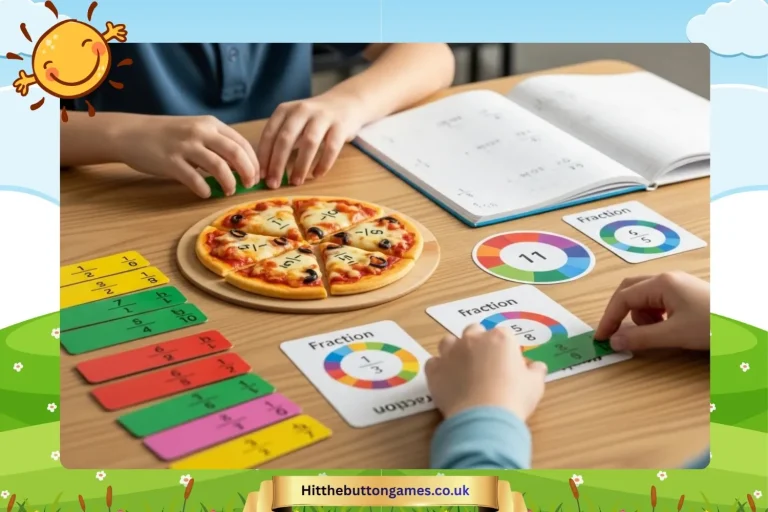
A fraction wall is a visual tool that shows fractions as parts of a whole. Imagine stacking colored bars where each bar represents a fraction. By looking at these bars, you can see how different fractions fit together, which makes it easier to understand concepts like equivalency and comparison.
Using game like this helps learners see patterns. For example, two quarters line up with one half, or five fifths equal a whole. This visual approach strengthens understanding far more than just reading numbers on a page.
Fraction math game break a whole into smaller, equal pieces. Each row shows a different division of the whole. The top row usually represents one whole, and each row beneath splits it into halves, thirds, quarters, and so on.
This setup allows students to:
- Compare fractions visually
- Spot which fractions are equal
- Understand how fractions can add up to a whole
By seeing fractions in color-coded sections, learners quickly grasp ideas that might be confusing in abstract form.
You do not need fancy tools to make a fraction wall. All you need are paper, markers, a ruler, and scissors.
Step-by-step guide:
- Draw a long rectangle to represent a whole.
- Divide it into sections for different fractions. Start with halves, then thirds, quarters, etc.
- Color each section differently to make it easy to identify fractions.
- Label each part with its fraction value.
- Stack the rows to create the wall.
Making your own wall helps you understand fractions more deeply. You see how pieces of a whole relate to one another and how combining fractions works.
Math game are not just for looking at; they are interactive learning tools. Students can use them for challenges such as:
- Comparing fractions: Align rows to see which fraction is larger or smaller.
- Adding and subtracting fractions: Visualize how pieces combine or separate.
- Finding equivalent fractions: Spot fractions that take up the same space on the wall.
- Ordering fractions: Arrange sections from smallest to largest.
Teachers can turn these exercises into games or group activities, making learning fractions fun and engaging.
This can can be adjusted for different ages and skill levels:
- Beginner walls: Use simple fractions like halves, quarters, and eighths. Focus on clarity and easy-to-read sections.
- Advanced walls: Include fractions up to twentieths or more complex divisions. This is helpful for older students who are practicing challenging problems.
Some walls even go up to one hundred parts, which is great for high-level fraction exercises and visualizing percentages.
Even with a fraction wall, mistakes can happen. Watch out for these common errors:

- Misreading fraction sizes: A smaller denominator does not always mean a smaller fraction. Always check the visual alignment.
- Incorrectly identifying equivalent fractions: Make sure to compare the length of sections carefully. Double-check by stacking rows to confirm equivalency.
By addressing these issues, learners can gain confidence in working with fractions.
For more engagement, fraction walls can be used in interactive ways:
- Printable walls: Students can color and cut out their own walls at home or in class.
- Digital versions: Tools like the MathsBot fraction wall let students explore fractions on tablets or computers.
- Math challenges: Teachers can create questions, puzzles, or timed activities to strengthen skills.
These activities make fraction learning active, not passive, which improves understanding and retention.
This Game give learners a clear view of fraction relationships. They:
- Build a strong foundation for adding, subtracting, and comparing fractions.
- Support visual learners by turning abstract numbers into visual segments.
- Make math challenges easier and more enjoyable, encouraging practice without frustration.
They are simple tools that have a big impact on math confidence.
Yes. With paper, markers, and a ruler, you can create a wall for any fraction level you need.
Fraction walls work for all ages, from beginners learning halves and quarters to advanced students exploring complex fractions.
Yes, platforms like MathsBot offer interactive fraction walls online, making learning accessible and engaging.
They allow you to visualize fraction problems, compare sizes, find equivalents, and practice addition or subtraction.
Absolutely. Walls can be designed to go up to twenty, fifty, or even one hundred parts for advanced exercises.
A fraction wall is a simple tool that turns learning fractions into an engaging visual experience. By helping students see and interact with fractions, it makes understanding equivalence, comparison, and addition much easier.
Whether in a classroom or at home, fraction walls can transform how learners approach fractions, building confidence and skill step by step. For more fun math practice, check out the Times Table Tennis math game to strengthen your skills while playing.