Number Bonds Made Easy for Confident Young Learners 2026
Teaching early math can feel frustrating. Some kids freeze when they see numbers, others zoom through and make careless mistakes. Number bonds are one of the best places to begin if you want children to feel confident with addition and subtraction.
Number bonds help kids see how numbers relate to each other. They don’t just memorize facts, they understand how numbers break apart and come back together. When this idea clicks, math becomes easier and less scary.
Let’s walk through what works, why it works, and how you can make it simple at home or in the classroom.
Number bonds show how a number splits into two parts. For example, 10 can split into 7 and 3, or 6 and 4. Children learn that parts make a whole.
This idea builds strong mental math skills. When kids understand number bonds to 10, they solve addition and subtraction faster because they see patterns instead of guessing.
In number bonds grade 1, this skill becomes the foundation for everything that follows. Without it, many students struggle later with larger numbers.
Children learn best when they see and touch things. Number bonds give them a visual and hands on way to understand numbers.
Instead of memorizing 8 + 2 = 10, they understand that 10 is made from 8 and 2. That understanding sticks much longer than rote learning.
Number bonds also help with:
- Mental math speed
- Subtraction confidence
- Fact fluency
- Pattern recognition
Always begin with small numbers. Start with number bonds 5. Children can use fingers, counters, or drawings to see how 5 breaks apart.
Once they feel confident, move to number bonds to 10. Ten is important because our number system is based on ten. When kids master bonds to 10, they can solve many problems in their heads.
Simple Practice Idea
Give a child 10 small objects like buttons. Hide some in your hand and leave the rest on the table. Ask, “How many am I hiding?”
They quickly learn to think, “I see 6, so 4 must be hiding.” That is real understanding. Hit the button Math Games offer more games like this.
After children are confident with 10, introduce number bonds to 20. At this stage, they should start visualizing instead of counting each object.
You can connect bonds to 20 with bonds to 10. For example:
14 = 10 + 4
Then break 4 into 2 + 2 if needed.
This builds flexible thinking.
Games turn practice into something kids enjoy. A good number bonds game keeps children thinking without pressure.
1. Roll and Make
Use two dice. Roll them and add the numbers. Ask the child to name another pair that makes the same total.
This builds flexibility and deeper understanding.
2. Find the Missing Part
Write 10 on top of a page. Under it, write:
10 = 3 + ___
10 = 8 + ___
Let kids fill in the missing numbers. Turn it into a race or challenge against a timer.
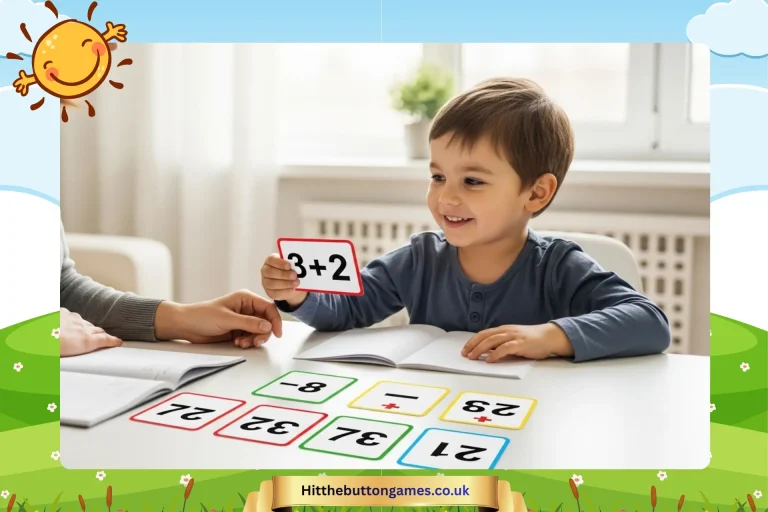
3. Number Bond Card Match
Create cards with whole numbers and matching pairs. Children flip cards and match parts to the correct whole. This strengthens memory and number sense at the same time.
These worksheets can be helpful, but only if used correctly.

Do not rely only on worksheets. Worksheets are best after children already understand the concept with objects or games.
Good worksheets should:
- Include missing number problems
- Use visual bond circles
- Mix addition and subtraction
- Gradually increase difficulty
Short daily practice works better than long, tiring sessions.
Music helps children remember patterns. A simple number song can make practice feel fun instead of repetitive.
You can create your own chant like:
“Eight and two make ten,
Seven and three again.”
Repeating number pairs through rhythm improves recall. Songs are especially helpful for children who learn better through sound.
Many adults rush children into larger numbers too quickly. Mastery of bonds to 10 must come first.
Another mistake is focusing only on addition. Always connect bonds to subtraction. If 6 + 4 = 10, then 10 − 6 = 4. This builds full understanding.
Also avoid timed drills too early. Speed comes after confidence.
Every child learns differently.
Visual learners benefit from circles, part whole diagrams, and color coding.
Hands on learners need counters, beads, or blocks.
Auditory learners remember better with a number bonds song.
Mix methods to reach every child.
At home, keep practice short and playful. Five to ten minutes daily works well. Use household items like spoons or coins.
In the classroom, small group games work best. Pair stronger students with those who need support. Encourage discussion so students explain their thinking.
Benefits
- Builds strong number sense
- Improves mental math
- Supports future multiplication and division
- Reduces math anxiety
Limitations
- Requires consistency
- Needs hands on introduction before worksheets
- Can become boring without variety
The key is balance. Combine games, songs, and written practice.
If math feels hard for a child, the problem often starts with weak number sense. Teaching number bonds for kids in simple, playful ways builds that missing foundation.
Start small. Use objects. Play games. Add songs. Practice daily in short sessions.
When children truly understand how numbers connect, math stops being confusing. It starts to make sense.